Epeus' epigone

Edifying exquisite equine entrapments

Friday, 7 April 2006

Patent Trolls

I broadly agree with Paul Graham's essay on Software Patents, but I do think he underestimates the damage from patent trolls, and from what he calls the mafia-like behaviour of some patent holders.

Paul has been lucky in the field he has worked in, but in the Audio and Video area there are many patent thickets. Perhaps it is the history of Farnsworth's victory over RCA that makes video engineers patent hungry.

My first startup, The MultiMedia Corporation, was a spin-out from the BBC in 1990. One of our products was a program called MediaMaker that combined video from tape or videodisc, CD Audio, Pictures, digitised audio and Director animations into picture icons on a timeline for making presentations. It was demoed on stage at Macworld by the CEO of Apple, and we got Macromind to publish it.

Then the patent troll showed up. A company called Montage had made a video editing system that included several video monitors showing edit points from tape. The company had gone out of business but a lawyer had bought up the patents, including one on using a still image to represent a video sequence. The troll was working his way round the video companies, and he caused enough trouble to stop work on the product while we worked on a legal defence instead.

Later, while I was at Apple on QuickTime, there was a steady stream of patent trolls claiming that Apple should pay them royalties; enough to keep several lawyers busy, and a lot of engineers spending time working on prior art evidence demonstrations.

Several potential features were excluded from QuickTime due to patent thickets. The obvious one was the Unisys LZW patent that encumbered GIF, but there were other more subtle pressures that meant adopting open source codecs was discouraged. Working on the patent license agreements for MPEG meant that technology ready to ship was deferred pending legal agreement on more than one occasion.

So I'm much lass sanguine than Paul about this. I think software patents should not be granted, and the European Union's banning of them is the right decision. I hope the Gowers Review in the UK makes this UK law as well.
Posted by Kevin Marks at 23:54 3 comments:
Labels: Apple, digital rights, law, Open Rights Group, ORG, patents, politics, QuickTime, video

Tuesday, 4 April 2006

Video on the net is a solved problem, many times over

So why are AT&T and Verizon arguing they need special legal exemptions to build an internet for video? This article is buried in misconceptions so deep, it's hard to know where to start. The basic argument is that in order to provide streaming movies over the internet, they need to build a dedicated connection between content companies and viewers. This is demonstrably false on several levels.

First of all, streaming is pointless - it's applying the TV model to the net, which doesn't fit. The only reason to stream video is if it is live and two-way - an audio or video chat, an interactive game, or a conference with backchannel. In those cases, you can perceive lag between the ends, and you need latency kept low enough - well under a second for the first two, around 10-15 seconds for the third. We can do this over the public internet today, using Skype, iChat AV and QuickTime Broadcaster (among others - I worked on the last two, so you can excuse me mentioning them).

But you don't need low latency for movies. QuickTime has been using plain webservers to serve video for 10 years, very sucessfully. In fact, Netflix have built a very successful movie business over a content delivery network with very high latency, called the US Post Office.

If you do want to deliver movies over the net, and they get popular, your servers and your upload connection may get overloaded (especially if you are an individual user that the telcos have sold an Asymmetric DSL line instead of the fibre to the home they promised us 10 years ago in their last bout of special pleading).

Fortunately there are hosting companies that will cache it for you in their datacenters, like youtube or mac.com. If your movie gets really popular, what helps is distributed caches, closer to the people downloading. Akamai run a service that offers this to companies with lots of money - Apple use it for their high definition trailers.

If you can't afford that, don't worry, we've solved that one too - Bittorrent provides a way for everyone downloading the movie to act as a cache for each other, so you only need a single server seeding them all - Prodigem makes this nice and easy.

So, none of this needs special new 'dedicated pipes', or a VPN. They lost that argument before with ISDN and reserved bandwidth - it was a bad idea then, and it still is, but apparently telcos can't let go of the circuit switched model, even when their circuits have all been replaced by internet protocol.

What makes all these choices for sending video over the net possible is precisely the content-independent end to end principle that the telcos want to throw out so they can privilege their 'dedicated pipes' of packets over ours. Their argument is a tottering inverted pyramid of bullshit, and they need to be called on it publicly.

Technorati Tags: bittorrent, digital rights, f2c, Live TV is Dead, podcasting, politics, QuickTime, streaming, television, video

Posted by Kevin Marks at 23:49 No comments:

Monday, 3 April 2006

Evolved Economics

Doc's post on Nat's blog about morality:
We can approach everything through one of three moral systems:
Morality of self-interest
This gives us "owning", "domination", etc. The Old School. Industrial Age shit. Still prevails in many business plans that are just for killing other companies.
Morality of accounting
We balance everything. "Paying debts", "owing favors". This is our system of justice, by the way. It's all about accounting. (Note the scales of justice symbol.)
Morality of generosity
We give. We are open. We love without expectation of reward, or even accounting. (In fact, when you bring in accounting, you compromise it.) Think about how we give to our spouses, our children, without strings. It pays off, too. But that's fundamentally not what it's about.

This reminded me of a passage in Steven Pinker's The Blank Slate:

The anthropologist Alan Fiske has surveyed the ethnographic literature and found that virtually all human transactions fall into four patterns, each with a distinctive psychology. The first is Communal Sharing: groups of people, such as the members of a family, share things without keeping track of who gets what. The second is Authority Ranking: dominant people confiscate what they want from lower-ranking ones. But the other two types of transaction are defined by exchanges.

The most common kind of exchange is what Fiske calls Equality Matching. Two people exchange goods or favours at different times, and the traded items are identical or at least highly similar or easily comparable. The trading partners assess their debts by simple addition or subtraction and are satisfied when the favours even out. The partners feel the exchange binds them in a relationship, and often people will consummate exchanges just to maintain it. For example, in the trading rings of the Pacific Islands, gifts circulate from chief to chief, and he original giver may eventually get his gift back. (Many Americans suspect this is what happens to Christmas fruitcakes). When someone violates an Equality Matching relationship by taking a benefit without returning it in kind, the other party feels cheated and may retaliate aggressively. Equality Matching is the only mechanism of trade in most hunter-gatherer societies. Fiske notes that it is supported by a mental model of tit-for-tat reciprocity, and Leda Cosmides and John Tooby have shown that this way of thinking comes easily to Americans as well. It appears to be the core of our intuitive economics.

Fiske contrasts Equality Matching with a very different system called Market Pricing, the system of rents, prices, wages and interest rates that underlies modern economics. Market Pricing relies on the mathematics of multiplication, division, fractions and large numbers, together with the social institutions of money, credit, written contracts and complex division of labour. Market Pricing is absent in hunter-gatherer societies, and we know it played no role in our evolutionary history because it relies on technologies like writing, money and formal mathematics which appeared only recently.[...]

When people have different ideas about which of these four modes of interaction applies to a current relationship, the result can range from blank incomprehension to acute discomfort or outright hostility. Think about a dinner guest offering to pay her host for the meal, a person barking an order to a friend, or an employee helping himself to a shrimp off the boss's plate. Misunderstandings in which one person thinks of a transaction in terms of Equality Matching and another thinks in terms of Market Pricing are even more pervasive and can be even more dangerous. They tap into very different psychologies, one of the intuitive and universal, the other rarefied and learned, and clashes between them have been common in recent economic history


David Weinberger, in his speech at F2C today, referred to the spurious appeal to fairness made by publishers of cultural goods, that the creator should be paid for any benefit received from a cultural good. This is stated at more length in Fair but Wrong.
Which brings me back to DRM - Ed Felten notes that Korean music publishers have quantified DRM's value destruction at 40%, which is more than the iTunes differential from CDs, though there the convenience factor is worth something too, though the downloadable movies at twice the price of DVDs scheme is sure to fail.

Technorati Tags: digital rights, DRM, economics, education, ethics, f2c, iPod, law, meme, movie, Open Rights Group, politics, rhetoric, video

Posted by Kevin Marks at 23:47 No comments:

Saturday, 1 April 2006

Unexpected agreement?

I've been saying for a while that the left/right split is often irrelevant to the politics around the net; it is much more about freedom and control, about trusting the public en masse or fearing them.
I have two illustrations of agreement across political lines tonight. First, danah boyd and Bill O'Reilly of Fox News in striking agreement over myspace.

Secondly, Tara Hunt's Marx-citing on marketing:
But re-reading the Communist Manifesto, I was, once again, swept up in the following passage:
When, in the course of development, class distinctions have disappeared, and all production has been concentrated in the hands of a vast association of the whole nation, the public power will lose its political character. [...]

THE COMMONS WILL OWN THE MEANS OF PRODUCTION AND WILL CALL THE SHOTS. I don't know about you, but that sounds pretty rockin' to me. But then again, I have faith in human beings.

aligns with Mark Steyn and Glen Reynolds as cited in Steyn's review of Army of Davids:
The professor thinks we're in a transformative moment: "the triumph of personal technology over mass technology. . . . Starting around 1700, big organizations became the most efficient way to do a lot of things," he writes. But today, "economies of scope and scale" no longer favour the big, and those organizations that don't get it are like the old joke about the Pravda headline boasting that the Soviet Union made the biggest microchip in the world. "The empowerment of individuals," says Reynolds, "may lead to an interesting twist on Karl Marx's goal: workers control the means of production, all right, but it's a far cry from Communism."

That rang a vague bell with me and, after rootling through my mouldering clippings, I found an old column of mine from five years ago -- before Reynolds had started Instapundit or I'd even heard of "blogs." "We have arrived at the situation Marx and Engels urged upon us, in which the proletariat would rise up and seize control of the means of production," I wrote. "Their only mistake was that they were envisioning a workers committee running the local steel mill. But the steel mills have gone, and today the biggest industry in the United States is entertainment. That's the one the masses are kicking down the factory gates of."

It's not just media.
Posted by Kevin Marks at 01:48 No comments:

Friday, 24 March 2006

AjaxWrite - a huge missed opportunity

So Michael Robertson has introduced AjaxWrite as a web-based word-processor. Nice idea, except what formats does it save to?
MS Word, RTF, Text and PDF.
How about HTML+CSS - it's how you're displaying the damn thing to me after all - how hard is it to store it in that format?
This is not a new question - after all CSS is more capable than Word's internal styling.
How about a Document Microformat? We can call it HTML for short.

Technorati Tags: AJAX, AjaxWrite, meme, Michael Robertson, microformats, Word

Posted by Kevin Marks at 15:39 No comments:

Wednesday, 22 March 2006

Deal or No Deal

David Hornik wrote a post comparing VC and buyouts to the TV show Deal or No Deal.

Now, my sons like watching this show, and I don't mind as it is a great lesson in probability. The expected value is pretty easy to calculate (sum of remaining amounts divided by number of remaining suitcases), so you have an objective valuation to compare the banker's offer against. Doing the calculation in your head isn't that hard, as you only need to sum up the top few amounts — lower ones don't significantly affect the outcome. The offers from the banker are consistently below the actual expected value, until they get down to a small number of cases.

At it's core, this program is in the same Greek God model of reality TV I have discussed before; unlike "Who Wants to be a Millionaire", which has a skill element alongside the "stop or continue" calculation, it is playing on the fact that knowledge of probability is not something that has been evolutionarily selected for, and thus needs to be painstakingly learned (if you doubt this, look at the city that probability built, Las Vegas). This reveals itself in Howie Mandel saying flagrantly untrue things like "there is a good chance you have a million dollars in your case" when there are 20 left, and so the chance is 5%, and indeed in the way the producers seem to be trying hard to get someone to win a million (which is hugely unlikely given the game's form, as when you are left with 2 cases, the buyout offer is very easy to calculate) - to the point where they are adding in cases with $2 million and $3 million in.

So how does this fit with Hornik's analogy? One thing that is clear is that if there isn't an objective way to value what you have, it helps if there is more than one banker to make you offers. If it is just Google, Yahoo or Microsoft, then the entrepreneurs may be in a take it or leave it situation, but if there are competing bidders, they have a better chance. It is this that makes sense of the otherwise inexplicable flotation of a public company of ex-Apple execs with no products or services, who want to buy up companies using IP.

PS If you look at the Deal or No Deal application form, it makes it very clear that watching you and your family and friends agonise over the decisions is the whole point of the show, and interestingly, alongside questions about criminal convictions also asks:

Have you ever created a website or posted any materials on any website? YES NO (Circle One) If YES, describe the website(s) you created and/or the materials you posted.


Have you appeared in any magazines, publicly disseminated photographs, advertisements or the Internet?


Technorati Tags: television, VC, Venture Capital

Posted by Kevin Marks at 11:04 No comments:

Tuesday, 21 March 2006

Microformats and Microsoft

Bill Gates endorsed Microformats at Mix '06 yesterday. Here's the clip in Windows Media format, and QuickTime format (thanks Brian).
Transcript:

BILL GATES:Everything we do here has to be incredibly flexible, because you're going to be doing your own sites, you might want things that are specific to your industry that, of course, Microsoft isn't going to have those things, so you need total flexibility because you're addressing all the different layers of the stack there.

And so all the interoperability standards here, whether it was XML to start with that we were a key part of giving that out as a standard, then the SOAP-level stuff, now we've moved up to a variety of techniques including Web services, all of those things are out there and free for people to use. Even the recent stuff that Ray has done about the simple list extensions, Live Clipboard, that's connecting up to everyone.

TIM O'REILLY: That's true, that stuff really wowed people when he demoed it at our e-Tech Conference. I thought, you know, this whole idea of the semantic Web is actually starting to happen in small ways with microformats, and I thought the fact that Ray picked up on that was really nice, he got a really great response from the geeks who were my audience.

BILL GATES: Well, I think his analogy that we've been exchanging data and had some standard formats within a machine, that he now would take that to, okay, let's exchange between different Web sites, it's going to take the idea of contact cards, scheduled appointments, set of directions, all these things where we move standard schema, we need microformats that people agree on, it's going to let that bootstrap. Because the more those things become standard, the more other Web sites choose them, and therefore the more popular they become.

TIM O'REILLY: Right, so that you get the network effects that really allow us to weave applications together.

BILL GATES: Right. And it's all very market driven. If some format is too rigid, then nobody is locked into that, somebody can come along and do something completely different.


It's great to see the work we've been doing on Microformats being picked up. Here's me telling Ray Ozzie about them less than a year ago: Windows Media format.


Technorati Tags: Bill Gates, meme, microformats, microsoft, Mix06, Tim O'Reilly, web 2.0

Posted by Kevin Marks at 15:41 No comments:

Tuesday, 14 March 2006

Memetic co-option


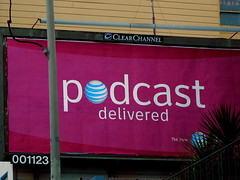
Podcast Delivered
Originally uploaded by Mermaniac.

At eTech (and apparently at SXSW too), Bruce Sterling spoke about the power of names in forming our mental representations of things. The example that leapt to mind is 'Podcasting', and seeing this AT&T billboard today brought it home for me.
When we were talking about 'automatically downloading audioblogs' it took lengthy explanations for people to grasp it at all, but now radio stations and legacy telcos can blithely throw the word around and people get it at once.

Before the iPod appeared, the idea of a personal music library had been around for a while, notably in Bruce's Heavy Weather (1994):

Jane turned on the radio, heard a great deal of encrypted traffic from banks, navigation beacons, and hams, and turned it off again. Funny what had happened to the broadcast radio spectrum. She turned on the car's music box. It held every piece of music that had ever meant anything to her, including stuff form her early childhood that she'd never managed to erase. Even with sixteen-digit digital precision, everything she'd ever recorded took up only a few hundred megabytes, the merest sliver in the cavernous memory of a modern music box.

Jane played some Thai pop music, cheerful energetic bonging and strumming. There'd been a time, back in design school, when Thai pop music had meant a lot to her. When it seemed that a few dozen wild kids in Bangkok were the last people on earth who really knew what it meant to have some honest fun. She'd never figured out why this lovely burst of creativity had happened in Bangkok. With AIDS still methodically eating its way into the vast carcass of Asia, Bangkok certainly wasn't happier than most other places. Apparently the late 2020s had just somehow been Bangkok's global moment to shine. It was genuinely happy music, bright, clever music, like a gift tooth world. It felt so new and fresh, and she'd listened to it and felt in her bones what it meant to be a woman of the 2020s, alive inside, and aware inside.

It was 2031 now. The music was distant now, like a whiff of good rice wine at the bottom of an empty bottle. It still touched something inside her, but it didn't touch all of her. It didn't touch all the new parts.


Or in Richard Turnnidge's 1991 mockup of an interactive radio player. Sometimes ideas take a while to accrete enough cultural baggage to be built.


Technorati Tags: 1991, 2006, etech, iPod, meme, podcasting, SXSW

Posted by Kevin Marks at 16:07 No comments:

Tuesday, 7 March 2006

Ray Ozzie's microformat clipboard

Last night at eTech, I was chatting with Rohit and Chris about microformats browser integration. With our Microformats talk today coming up, Rohit said something like "our hCard and hCalendar demos work great on the Mac, but they don't get stuff into Outlook on Windows".

This morning, Ray Ozzie demoed his Live Web clipboard. This gives a way to add a scissors button to webpages to copy structured data out, and a system tray app to translate to and from the native clipboard.

This means you can take hCalendar and hCard data from the web into Outlook, into MSN's Live calendar application, and connect other apps data into and out of the browser in a nice user-obvious way. Great stuff.

Technorati Tags: etech, etech06, meme, microformat, microformats, microsoft

Posted by Kevin Marks at 13:05 No comments:

Friday, 3 March 2006

Sometimes it is Rocket Science...

Michael Mealling works for a company that makes space rockets, and he has an idea for your next science fair - how about sending a kilogram into space and back for $250?

If that sounds intriguing, they have a survey for schools (and homeschools) to fill in to see if they can get enough people together to fill a 100kg payload rocket.

Technorati Tags: education, homeschool, rocket science, science fair, space

Posted by Kevin Marks at 16:23 No comments:

Thursday, 2 March 2006

AT&T and Suw illustrate my point below

AT&T paid millions to run an ad that emphasises the wires in the network.
If they do their job right, we are unaware of the wires.

Conversely, Suw of ORG speaks clearly and coherently to DRI for 40 minutes on the threats to an open net. This is well worth watching - I learnt a lot and I've been trying to follow these issues myself.

This also illustrates the deeper point - the net can as easily bring us video from a small group of thoughtful and engaged people as from a trillion-dollar corporation. The head of AT&T wants to take back the pipes from the open net, and stop us putting up video without paying them extra.

Senator Ron Wyden introduced an Internet Nondiscrimination Bill today, which sounds encouraging.

Here's my parody of the AT&T ad - with narration changed to say what they mean.


PS A tip for Google videos in general. The default Flash player looks ratty and has trouble maintaining sync. Click on the 'Download for iPod' mpeg4 version and play that in VLC, iTunes or QuickTime Player. Why Google won't let us fast-start these I don't know.

Technorati Tags: Digital Commonwealth, digital rights, Live TV is Dead, movie, Open Rights Group, ORG, politics, rhetoric, video

Posted by Kevin Marks at 21:51 No comments:

Monday, 27 February 2006

DRM wisdom and Tag dreams

John Scalzi explains why he, Patrick Nielsen Hayden and Tor will not be putting DRM on their e-Books. Great to see authors and publishers being smart here, and not falling for the DRM traps.
Stavros the Wonderchicken is thinking about how tags can grow into virtual worlds.

Technorati Tags: auctorial, digital rights, DRM, tags, writing

Posted by Kevin Marks at 22:30 No comments:

Tiered versus Weird

I have made this contrast before, and I think it is another key framing distinction in the net debate.
Internet cloudNetwork engineers draw the Internet as a cloud, because it doesn't matter to endpoints how the packets get there. The packets get routed, but the protocols are designed to cope with messiness, with buffers overflowing, and computers crashing, and wires being unplugged or ripped up by backhoes. This is the mental model the end-to-end principle encourages - the net is just where packets come from and go to, and has a big 'Somebody Else's Problem' field around it. This is one place where engineers and normal people converge - they don't think about how stuff gets there, they just enter a website or email or IM address and there they are.
Internet thought balloonBy contrast, telco's and networking providers, naturally, do see the wires and the complexity, because that's what they do. They can't use the SEP method, so they fall back on thinking hierarchically, which is another way of coping with complexity. This contributes to the difficulty of getting the open network argument across to governments - the hierarchic frame is a good fit for their default approach to organisation and information flow, so regulatory capture is a likely outcome.
There are countervailing ideas in political thought across the political spectrum, from commons theory to anti-trust and deregulation. The immense success of WiFi's tiny slice of free spectrum is promising, but as Doc, Eric and Mitch and Jon point out, the attack on net neutrality is building. We need to keep trying out metaphors of openness and freedom, invisible hands and co-operation, until we find one that fits.

Technorati Tags: caliban, Digital Commonwealth, digital rights, ethics, meme, Open Rights Group, ORG, politics, rhetoric

Posted by Kevin Marks at 19:30 1 comment:

Friday, 24 February 2006

Internet regeneration

The internet is up for debate again. I'd like to connect the thoughts of 3 smart women and one dead white male.

What I see is a generational divide - there is my generation, who built the internet; the protocols, the applications and are filling it with our thoughts and ramblings. For this generation, I'd claim Douglas Adams, whose 1999 essay I keep returning to. Do go read the whole thing; I'm going to cite a small part of it today:

we are still the first generation of users, and for all that we may have invented the net, we still don't really get it. In The Language Instinct, Stephen Pinker explains the generational difference between pidgin and creole languages. A pidgin language is what you get when you put together a bunch of people — typically slaves — who have already grown up with their own language but don't know each others'. They manage to cobble together a rough and ready lingo made up of bits of each. It lets them get on with things, but has almost no grammatical structure at all.

However, the first generation of children born to the community takes these fractured lumps of language and transforms them into something new, with a rich and organic grammar and vocabulary, which is what we call a Creole. Grammar is just a natural function of children's brains, and they apply it to whatever they find.

The same thing is happening in communication technology. Most of us are stumbling along in a kind of pidgin version of it, squinting myopically at things the size of fridges on our desks, not quite understanding where email goes, and cursing at the beeps of mobile phones. Our children, however, are doing something completely different.

danah boyd has been talking to our children, the MySpace generation, who have grown up with pervasive networking, and are making it their own place, a parallel world interwoven into their real-world lives:

What we're seeing right now is a cultural shift due to the introduction of a new medium and the emergence of greater restrictions on youth mobility and access. The long-term implications of this are unclear. Regardless of what will come, youth are doing what they've always done - repurposing new mediums in order to learn about social culture.

Technology will have an effect because the underlying architecture and the opportunities afforded are fundamentally different. But youth will continue to work out identity issues, hang out and create spaces that are their own, regardless of what technologies are available.


Suw Charman, of the Open Rights Group, spoke at the RSA on the internet golden age this week (there is a full mp3 recording of the debate). I'm extracting Suw's conclusion:

Our hope is in teenagers, because they have grown up with the internet in a way that none of us have. For them this is all second nature - they will route round the damage that is done, but we have to make sure there is not too much damage for them to try and heal.

Susan Crawford, of OneWebDay, wrote a discussion of framing that talks of the founding fathers who say the Internet is a collection of standards that allow the networking of computers, the users who say the Internet is the collection of interactions and relationships that happen online, and contrasts them with the telcos who say that "the Internet" is about cables and connections that they charge for.

This leads us to a different generation, the politicians and incumbent executives who have prospered in a narrow culture of favours exchanged behind closed doors, of regulatory creation of monopoly rents, and who look at the next two generations with fear. It is up to us to make sure that the dynamic spontaneous orders that are continually being created with the Internet's help are not choked off by a backlash from the old order.

My generation draws the Internet as a cloud that connects everyone; the younger generation experiences it as oxygen that supports their digital lives. The old generation sees this as a poisonous gas that has leaked out of their pipes, and they want to seal it up again. This is why we need to fight for our spontaneous orders.

Ultimately, I believe the our more open way will succeed through it's very creative, positive-sum nature, but that does not mean we should complacently stand by.


Technorati Tags: caliban, Digital Commonwealth, digital rights, ethics, meme, Open Rights Group, ORG, politics, rhetoric

Posted by Kevin Marks at 23:07 No comments:

Thursday, 23 February 2006

Simple rule - if you write, get a blog

Today's flash of the bleedin' obvious was that blogs by writers tend to work well. On the face of it, this is a banal observation, but finding the blog by the Grey's Anatomy writers, and Malcolm Gladwell's new blog, reminded me that anyone who writes professionally, who writes because they love it, and can't help but write, should get themselves a blog, so we can all share in the flow of ideas.

After all, just on my favorite's list I have Gaiman, Sessum, Scalzi, Charman, the Nielsen Haydens, Searls, Weinberger and Locke.

It may seem that you lot have a bit of an unfair advantage, but us amateurs do appreciate your good writing and try to learn from you.

Technorati Tags: auctorial, blink, blogs, writing

Posted by Kevin Marks at 23:56 No comments:
Newer Posts Older Posts Home
Subscribe to: Posts (Atom)

This is my personal blog. Any views you read here are mine, and not my employers'.

Atom Feed

Support the Open Rights Group
My photoKevin Marks Me on Twitter
Me on G+

People's thoughts I read:

Daily

Rosie
San Jose Young People's Theatre
Dave Weinberger
Doc Searls
Gonzo Engaged
AKMA
Cory & friends
Denise Howell
Charles Wiltgen
Shelley Powers
James Lileks
Suw Charman
Halley Suitt

Weekly

Andrew Marks
Blogsisters
Arts & Letters Daily
Bricklin, Frankston & Reed
Steve Yost
Jeneane Sessum
Brian Micklethwait et al
Tom Matrullo
Gary Turner

Sporadically

Small Pieces
Stuart Cheshire
RageBoy
Nonzero
Neil Gaiman
Thomas Vincent
Brad deLong
Andrew Odlyzko
ProSUA

No to Mickey Mouse Computers

powered by blogger

Blog Archive

  • ▼  2023 (1)
    • ▼  September (1)
      • Plus Theory
  • ►  2017 (2)
    • ►  May (1)
    • ►  April (1)
  • ►  2015 (7)
    • ►  November (2)
    • ►  May (3)
    • ►  April (1)
    • ►  January (1)
  • ►  2014 (3)
    • ►  October (1)
    • ►  April (2)
  • ►  2013 (5)
    • ►  June (1)
    • ►  May (1)
    • ►  April (2)
    • ►  March (1)
  • ►  2012 (8)
    • ►  December (1)
    • ►  May (1)
    • ►  April (1)
    • ►  March (1)
    • ►  January (4)
  • ►  2011 (11)
    • ►  December (1)
    • ►  November (1)
    • ►  September (2)
    • ►  August (2)
    • ►  July (1)
    • ►  April (2)
    • ►  January (2)
  • ►  2010 (16)
    • ►  November (1)
    • ►  October (1)
    • ►  September (3)
    • ►  June (1)
    • ►  May (2)
    • ►  April (2)
    • ►  March (2)
    • ►  February (2)
    • ►  January (2)
  • ►  2009 (22)
    • ►  November (2)
    • ►  October (2)
    • ►  September (2)
    • ►  August (3)
    • ►  July (2)
    • ►  June (2)
    • ►  May (2)
    • ►  April (1)
    • ►  February (2)
    • ►  January (4)
  • ►  2008 (29)
    • ►  December (2)
    • ►  November (3)
    • ►  August (1)
    • ►  July (3)
    • ►  June (3)
    • ►  May (5)
    • ►  April (2)
    • ►  February (3)
    • ►  January (7)
  • ►  2007 (45)
    • ►  November (3)
    • ►  October (4)
    • ►  September (4)
    • ►  August (10)
    • ►  July (3)
    • ►  June (8)
    • ►  April (2)
    • ►  March (6)
    • ►  February (3)
    • ►  January (2)
  • ►  2006 (119)
    • ►  December (13)
    • ►  November (8)
    • ►  October (16)
    • ►  September (10)
    • ►  August (3)
    • ►  July (6)
    • ►  June (24)
    • ►  May (3)
    • ►  April (10)
    • ►  March (7)
    • ►  February (8)
    • ►  January (11)
  • ►  2005 (101)
    • ►  December (10)
    • ►  November (13)
    • ►  October (9)
    • ►  September (8)
    • ►  August (7)
    • ►  July (7)
    • ►  June (8)
    • ►  May (12)
    • ►  April (7)
    • ►  March (6)
    • ►  February (1)
    • ►  January (13)
  • ►  2004 (53)
    • ►  December (8)
    • ►  November (5)
    • ►  October (6)
    • ►  September (7)
    • ►  July (5)
    • ►  June (3)
    • ►  May (2)
    • ►  March (3)
    • ►  February (7)
    • ►  January (7)
  • ►  2003 (196)
    • ►  December (12)
    • ►  November (14)
    • ►  October (21)
    • ►  September (23)
    • ►  August (19)
    • ►  July (11)
    • ►  June (14)
    • ►  May (9)
    • ►  April (22)
    • ►  March (20)
    • ►  February (16)
    • ►  January (15)
  • ►  2002 (224)
    • ►  December (15)
    • ►  November (21)
    • ►  October (22)
    • ►  September (12)
    • ►  August (11)
    • ►  July (28)
    • ►  June (19)
    • ►  May (29)
    • ►  April (18)
    • ►  March (19)
    • ►  February (16)
    • ►  January (14)
  • ►  2001 (13)
    • ►  December (2)
    • ►  November (11)

Contributors

  • Kevin Marks
  • Kevin marks