Epeus' epigone

Edifying exquisite equine entrapments

Monday, 26 September 2011

'with Amazon' replacing 'with Google' on Android?

Amazon is set to launch an Android Tablet on Wednesday. What if they license their code too? Android as experienced on phones is actually two separate software bundles - the Open Source core of Android, and the proprietary 'with Google' applications, including the App Market, Maps, Gmail, Talk, Contacts, Listen and other apps bound to Google services, and requiring a business development deal to ship with a device. Eric Schmidt explicitly discussed this strategy at Dreamforce.

Now there are already more Android devices than I can count that don't follow the 'with Google' playbook, including the Barnes & Noble Nook that probably inspired this response from Amazon, but there are hints of a broader strategy here. What if Amazon offered an alternative to Google's top half of Android? I think Amazon does not really want to be in the hardware design business, but wants to be sure that they can't be locked out of it or forced to pay extra by Apple, Google or any other potential competitor. As well as releasing their own 7" tablet, they could offer an Open Source or lightly licensed version of their stack to other hardware developers.

Why would Amazon do this? Because they are primarily in the shopping and media business. Apple has stopped them selling eBooks and media inside their apps on iPad/iPhone; Google has banned their App Store from the Google Android Market. Amazon could even offer a referral fee for anything bought via their store as an incentive for device manufacturers to ship it.

An even bolder step wold be to actually fork Android. Google has a delayed-open model for Android source, where a new version is released in public after a closed development process, without a clear way to send in patches to Google. Amazon could put their current version up on Github, accept patches, and treat Google's new drops as another source of possible patches.

Understanding each company's core business is what makes this likely. Apple is in the devices business, with the media business as a small side earner designed to make their devices more attractive. Google is in the Advertising business, with their Android business designed to make searching everywhere, continuously more likely. Amazon is in the shopping business, migrating from physical goods to media, with Kindle a way to drive this. A tablet that they can sell audio and video to as well as eBooks makes more sense to them if it as widely distributed as Kindle playback apps are now.

Posted by Kevin Marks at 17:17 No comments:
Labels: amazon, android, Apple, google

Tuesday, 20 September 2011

Is Netflix picking the right disruption?

The decision to split Netflix into two companies, with the poorly-named Qwikster getting the DVD by post business and Netflix keeping the streaming business has caused a lot of fuss. Bill Gurley suggests that this is due to the very different licensing regimes the two businesses work under, and Clayton Christensen has praised this an a rare example of a company pre-emptively disrupting itself.

However, Reed Hastings gave rather non-plussed responses to those who complained about not having the two queues (DVD and streaming) integrated. As danah said,

It may seem logical to split the world based on business models from the inside of a business, but if you want your business to succeed, you should be focusing on understanding your users' mental models. And those aren't organized along business lines. They're organized around movies that they like, obtained by the means that is appropriate to the particular context of that user. People understand Netflix through its database of movies and the ratings that they've spent time providing, not its distinct queues.

Hastings clearly isn't thinking about this from our point of view - we want to watch something, and are much less focused on the particular medium. Instead of separating the two modes, Netflix should be uniting them further - help us book cinema tickets too, or buy Blu-ray discs. Encourage us to bring in information on favourite films and TV shows from Facebook, Amazon, GetGlue. They still could do this in an exemplary way by having Netflix and Qwikster share users' information through public APIs that others could use too. Activity Streams was made for this.

Being on the users' side in this way is another disruption, and indeed several startups at TechCrunch Disrupt had this mindset - what Doc Searls's VRM project calls '4th party tools' - ones that mediate between the customer and the vendor on the customers behalf. Cake Health mediate between you and insurers, TalkTo between you and local shops, FlickMunk between you and cinemas, and u4them as a way to donate to others medical bills.

The deeper currents of disruption of the film and TV industry are showing up in music. At SF Music Tech last week, turntable.fm was on everyone's lips, as the site that has got us all sitting round playing music for each other again, like the older label execs fondly remember from the 1970s. What it has done is apply the semi-overlapping publics and sharing models of twitter to listening to music together.

The other critique of Netflix that I saw was Megan McCardle saying that they were freeloading on the studios by only paying the marginal cost. Someone has to fund the creation, she pleads with us. Again, the answer was assumed at SF Music Tech, in the form of Kickstarter, which explicitly encourages people to fund production, and not just at marginal cost either. A key part of a successful Kickstarter project is widely spaced payment options, the special deals that are really about showing support with largesse. That these are power-law distributed seems odd at first sight - why would people pay more? But in fact it makes perfect sense. Income and wealth are power-law distributed in the US too, so people can pick the level of patronage that fits their income.

Independent artists like Pomplamoose and Zoë Keating are not served by the commodity pricing of Spotify - many are removing their songs from the catalog; they'd rather host them for download themselves. Zoë reports that her Bandcamp site, which lets you pay as much as you like for an album, has received payments of $8 to $500. Because they want to support her.

Cory Doctorow once said that "If big-budget movies might turn into opera, then long-form narrative books might turn into poetry." Opera has long understood the power-law distribution of wealth, and seeks donations in the same kind of structure.

In some ways, this power-law distribution of price is visible throughout commerce in the US. You can pay anything from $1 to $5000 for a burger, with price points inbetween, similarly for housing, transport, drinks, clothing, shoes, you name it.

The old economic choice between a commodity business that's all about margins, or a fashion business that is about competing for the most popular spot is finding a new accommodation. The discovery mechanisms like Turntable, Spotify, Pandora, and yes even Netflix, need to connect to these artist empowering patronage sites, as well as the commodity playback from the industrial aggregators. They need to lead people to Kickstarter and Bandcamp too. They need to be convenient, comprehensive and supportive of those creating art.

Update:Zoë Keating on Spotify, Apple and Independents (and lettuce)

Posted by Kevin Marks at 15:59 No comments:
Labels: economics, movies, music, netflix

Saturday, 20 August 2011

Google Plus must stop this Identity Theatre

Bruce Schneier in Beyond Fear coined a phrase:

one of the goals of a security countermeasure is to provide people with a feeling of security in addition to the reality. But some countermeasures provide the feeling of security instead of the reality. These are nothing more than security theater. They're palliative at best.

The Common Names debâcle at Google Plus is a variant of this, where the supposed protections are manifestly not working. Google's stated policy on this is that you should use your 'common name' - normatively defined to have exactly two words in it, in a naïve English speaking way, that fails in a huge number of common English cases, let alone other languages.

Vic Gundotra has said

he is trying to make sure a positive tone gets set here. Like when a restaurant doesn't allow people who aren't wearing shirts to enter.

so it is explicitly designed to exclude 'people not like us' from the space.

Early users can set the tone for a network, but one that has aspirations to include most people will need to support multiple different communities within it. If you want a positive tone, you have to work at it, and empower the tummlers to maintain it. Teresa Nielsen-Hayden put it well:

1. There can be no ongoing discourse without some degree of moderation, if only to kill off the hardcore trolls. It takes rather more moderation than that to create a complex, nuanced, civil discourse. If you want that to happen, you have to give of yourself. Providing the space but not tending the conversation is like expecting that your front yard will automatically turn itself into a garden.

2. Once you have a well-established online conversation space, with enough regulars to explain the local mores to newcomers, they’ll do a lot of the policing themselves.

More from Teresa and from John Scalzi.

The initial flavour of Google Plus, because it was seeded by Googlers and other geeky folk they invited, was like pre-Eternal September Usenet - it had a cultural coherence because we were all geeks. As it grew to 25 million users, this could not hold.

Blogs deal with this by making it clear who the site owners are, and empowering them to manage commenters. Twitter does it by not showing you comments unless you chose to see the commenter, or if they address you directly. Google Plus is an uneasy hybrid of the two.

You can delete and block commenters on your postings, like a blog, and if you reshare someone's post, it starts a new comment thread, like a blog. However, anyone can @ or + your name and drag you into another comment thread via notification, and then you get notified of other follow-ups too, making griefing and harassment all too easy.

Enforcing 'common names' does nothing to help this; it just means your trolls and griefers will be using plausibly American-looking names that may or may not be their own, while those with unusual names, will either be excluded outright or easily preyed on by the griefers reporting them, which is what I suspect happened to Violet Blue tonight.

Once you are suspended, the verification process is crude and manual, and also easily gamed. Kellan warned about this problem:

If you’ve never run a social software site … let me tell you: these kinds of false positives are expensive.

They’re really expensive. They burn your most precious resources when running a startup: good will, and time. Your support staff has to address the issues (while people are yelling at them), your engineers are in the database mucking about with columns, until they finally break down about build an unbanning tool which inevitably doesn’t scale to really massive attacks, or new interesting attack vectors, which means you’re either back monkeying with the live databases or you’ve now got a team of engineers dedicated just to building tools to remediate false positives. And now you’re burning engineer cycles, engineering motivation (cleaning up mistakes sucks), staff satisfaction AND community good will. That’s the definition of expensive.

And this is all a TON of work.

And while this is all going down you’ve got another part of your company dedicated to making creating new accounts AS EASY AS HUMANLY POSSIBLE. Which means when you do find and nuke a real spammer, they’re back in minutes. So now you’re waging asymmetric warfare AGAINST YOURSELF.

This is the hole Google is now in. A surprisingly large number of people I know, who've been discussing civilly online for years, have fallen foul of Vic's Procrustean name rules. When they point this out, they're harrassed by 'Real named' dickheads telling them to shut up and change their name, both in public and by being +-summoned by the trolls, and they have to find Google plus's well-hidden blocking tools rather quickly. Or give up and go elsewhere.

Now, Google has announced that they are verifying some people's names, to prevent impersonation. Trouble is, they haven't said how . Twitter verifies celebrities via an opaque process. Amazon does it by checking your name matches a Credit Card. Google Search uses rel="me" and rel="author" microformats. What Plus does is unknown. One of my profiles is verified, possibly because I went through the verification process on Google Knol before.

This is also Identity theatre - Google saying 'trust us', rather than revealing the rel="me" link from the person's page that we already know.

Vic Gundotra needs to stop digging this hole. Scrap the normative 'common names' policy, add a coherent name verification and linked-site verification so we can tell the people we already know, and make moderation tools visible and available so we can curate the conversations ourselves.

With this, and an apology to those already ensnared by the existing process, he could maybe prevent Plus from being spoken of only alongside Wave and Knol.

More on this:

  • my.nameis.me has testimonials on the nuances of names
  • jwz is shocked by othering of the anonymous
  • The EFF's case for pseudonyms
  • Journalists tempted by slumming
Improved certificate
Posted by Kevin Marks at 05:42 27 comments:
Labels: google, Identity, nymwars, Tummeling

Thursday, 11 August 2011

David Cameron should heed Douglas Adams and ORG

Widely reported today are David Cameron's comments to parliament on riots and social media:

Mr Speaker, everyone watching these horrific actions will be stuck by how they were organised via social media.

Free flow of information can be used for good. But it can also be used for ill.

[And when people are using social media for violence we need to stop them.]

So we are working with the Police, the intelligence services and industry to look at whether it would be right to stop people communicating via these websites and services when we know they are plotting violence, disorder and criminality.

I have also asked the police if they need any other new powers.
(the bit in square brackets was in his press statement, but not read in the Commons)

This particular line of reasoning was magnificently rebutted by Douglas Adams in 1999:
Newsreaders still feel it is worth a special and rather worrying mention if, for instance, a crime was planned by people 'over the Internet.' They don't bother to mention when criminals use the telephone or the M4, or discuss their dastardly plans 'over a cup of tea,' though each of these was new and controversial in their day.

I was encouraged recently when the UK Govt abandoned web blocking plans in the Digital Economy Act. Understanding that the internet is there for common carriage (a mere conduit, as the EU puts it) is important. Even on its own terms this threat makes little sense: if people are plotting riots on social media, that is surely exactly the evidence you need to convict them under the UK's statutory Conspiracy law. The telephone, the M4 and cups of tea are much harder to use as sources of evidence.

The Open Rights Group, has a typically measured and thoughtful response to this.

Cameron should be careful, or he'll look to posterity like William Cobbett ranting about the pernicious evils of tea.

Posted by Kevin Marks at 11:22 2 comments:
Labels: conspiracy, DEBill, internet, UK

Sunday, 24 July 2011

Should 'Money' be an adjective, not a noun?

I've been following Ben Laurie's thoughts on Bitcoin and now his new paper on An Efficient and Practical Distributed Currency.

He envisages a group of 'mintettes' that can agree on the distribution of coins, transfer them between individuals, and mint new ones, deciding between themselves how to distribute these. I like the idea of the different mintettes having different Public Good type ideas of where the newly created coins get assigned. The key here is to grow the coin supply at a rate that is lower than the growth of value held, so holders of your coinage get some appreciation, and distribute the new money to worthy causes, or to clients of that mintette.

In effect you're doing an end run around Gresham's law, in the same way that the Brazilian Real did - and not how the US Govt is doing with dollar coins. This is the bit that the libertarian summer camp got backwards - although they traded with gold, they set prices in US dollars.

We do have a precedent for this, and it is an encouraging one. In effect, each company stock is a private currency. The success of Silicon Valley has been helped by the ability of companies here to mint this money-like stuff, and distribute it to stakeholders and investors alike. The difference is that they create new tranches of 'coins' at board meetings, though stock option vesting is a bit like the smooth currency growth that Bitcoin and Ben envisage. Again the goal is growing the money supply at a rate below demand, so that those holding it are rewarded.

In effect we already have things that are more or less like currencies, and these new ones have some encouraging precedents.

Posted by Kevin Marks at 20:40 1 comment:
Labels: Bitcoin, economics, money, Planet Money

Tuesday, 26 April 2011

Which Companion is the BBC treating us like this year?

A while back I complained that the BBC's parochial attitude that was making Neil Gaiman furtively obtain Doctor Who - expat fans were being treated like Madame de Pompadour in The Girl in the Fireplace, only getting the Doctor on DVD, after waiting long enough to die.

They solved this problem for Neil by having him write The Doctor's Wife, so he gets to carry round the series on a flash key. It almost seemed like the BBC got the message, boasting in the New York Times that the US premiere will not be delayed. But that was like the promise to Amelia Pond that they'd be right back, while we pay iTunes or Amazon for the new series, and are left sitting on our suitcase in our nightie and wellies, while nothing downloads for us.

Instead, because they fret archaically about TV ratings, we're supposed to wait 13 hours after the UK sees it, and then, like Rose in Journey's End, we're stuck in a parallel universe with a pale imitation of the Doctor - BBC America's letterboxed, pillarboxed, advertisement-infested, scenes-cut-for-time version that I truly hope Steven Moffat, Russell Davies, Neil Gaiman, and everyone else who worked so hard to imagine these adventures for us, never gets to see. It's like the Dream Lord from Amy's Choice seized control of the Tardis from us.

So what can we do? We can be like River Song in the Impossible Astronaut, and fly the Tardis properly, sweetly warn of spoilers, and get the episode from BitTorrent instead.

If the BBC were smart about this, they'd offer the diehard fans a pay-to-download package that started downloading during the UK première TV showing. If they were even smarter they'd charge a super premium to get access the same time they do the press previews the week before.

RIP Elisabeth Sladen, like us fans in the 90s, dropped off in the wrong place, with just memories and a bad robot dog to keep us going, but we held out hope and saw the Doctor again.

Posted by Kevin Marks at 03:17 7 comments:
Labels: BBC, BBC America, Doctor Who, DRM

Saturday, 9 April 2011

Ev's identity map ignores what we say

Ev Williams wrote a good blog post on identity yesterday, that I suggest you go and read. The odd thing is that he leaves out the publicly articulated thoughts that we use blogs, Twitter and other services to publish as an expression of our identity. Before I get to that, though, I'd like to connect his facets back to the open specs that represent these aspects.

Authentication

Ev mentions OpenID here, and is essentially correct that it is not helpful on its own. It was designed to verify URLs for blog comments. If all you do is use OpenID, you just replace logging into your site with logging into another, adding extra confusion without much benefit. However, once you have a URL for someone, you can then discover further information about them, by examining that URL and its links. Microformats can encode this directly in the webpage, or you can use related links to discover API endpoints for more.

The distinction between Authorization and Authentication is elided by Ev, and in practice OAuth has been winning out over OpenID as it is explicitly an Authorization APi that had Authentication as a side effect. The new OpenID Connect proposals try to remedy both these failing by using OAuth and by standardizing on how to list other endpoints.

Representation

Here Ev is looking for what is commonly called profile information. We have some mature standards for this - vCard is widely used by email clients, and is currently going through another standardization round to add modern features. The hCard microformat gives a simple way to embed profiles in web pages. Also, the rel="me" part of XFN makes it straightforward to link web pages together that represent different aspects fo your public representation. This is supported by Facebook, Twitter and Google, but sadly not by about.me whom Ev praises.

If you want a general data format for profile data, Portable Contacts is what you need.

Communication

Ev's emphasis on email addresses here illustrates the problem with them; they are primarily write-only; though we persist in using them for log-in IDs, they are not readily discoverable. The WebFinger spec gives a way round this - a way to go from an email to endpoints for other readable identity standards. Other communication standards have piggy-backed on email address, such as Jabber and Wave.

Personalization

This hints at the glaring gap in Ev's model, the expression of personal taste and preference. This is commonly done by reviewing, and we have the hReview microformat to express that, but it can also be useful just to track a history of media played or places visited to derive preferences over time. Here Activity Streams are an obvious fit, and it would be good to map such proprietary formats as Amazon purchases, Last.fm scrobbles, iTunes played songs and so on into a common format to derive this.

One model we can use for this is tagging - associating keywords with things. Many feed specs have tagging built in, and the rel="tag" microformat is a way of indicating these publicly.

Reputation

As Ev says, this is problematic, and also often highly contextual; I may trust someone's advice on restaurants without listening to them about which programming language to use. Reputation and trust are subtle, deeply human and very hard to model. The best answer here may be to rely on the power of faces and following; if we attach the face of someone we know to their public statements, we can decide for ourselves how much weight to give them.

Which brings me back to my opening point. When we decide who to pay attention to online, we tend to rely on what they say; if you get an @ reply on twitter, clicking on that person's name to see their most recent comments is hugely useful in deciding how much attention to pay to them. Similarly, the history of public blog posts, or their reviews of movies, music, books or restaurants arre other reasons we may follow them, and our identity is most strongly formed from the stories we tell and retell about ourselves. Feeds, whether in Atom, RSS or hAtom, and Activity Streams give rich representation of our thought, opinions and actions.

Whom we choose to associate with or follow is also an expression of our identity, and a useful signal when deciding how much attention to pay to someone, and XFN and Portable Contacts are both usefule in discovering these connections.

Dare Obasanjo also responded to Ev's Identity post, and added in payment as well as the friends as missed aspects. I'd love to discuss this further with both Ev and Dare at the Internet Identity Workshop next month, which is where many of the specs mentioned above were conceived and agreed. Maybe Ev can bring some others from Twitter with him too; their past contributions to OAuth were highly useful and there is plenty more to get our teeth into, as Ev's post shows.

Posted by Kevin Marks at 18:25 2 comments:
Labels: Activity Streams, hAtom, hcard, hReview, IIW, microformats, OAuth, OpenID, xfn

Tuesday, 18 January 2011

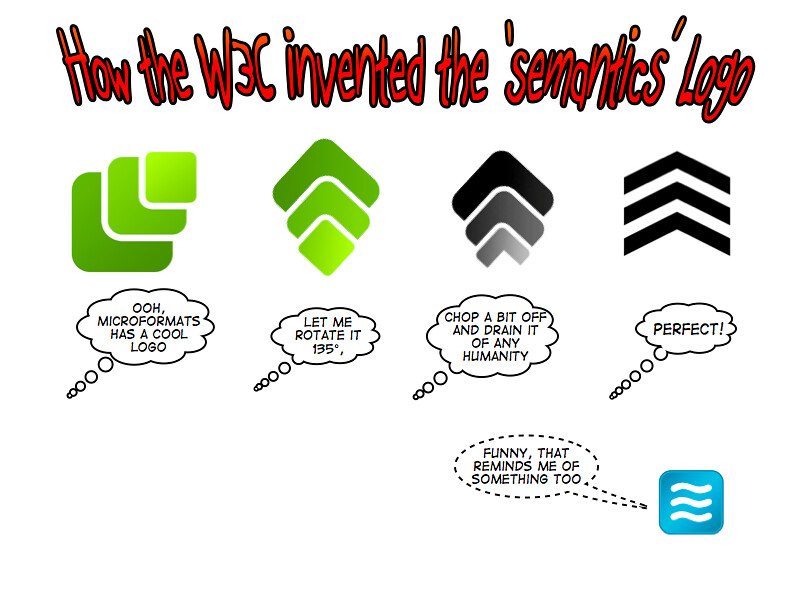
How the w3c invented the ‘semantics’ logo

Today the w3c launched an HTML5 logo, that includes sub-logos for different technologies included in or associated with the standard. Here's my parodic view of how the semantics one was made:
How the w3c invented the 'semantics' logo

Jeremy is upset that they're using 'HTML5' to include CSS3, SVG, WOFF too. I've seen SVG and CSS3 versions of the logo - who's got a WOFF one?

Update: I made a version of the logo in HTML only for the purists.

Posted by Kevin Marks at 12:52 1 comment:
Labels: CSS, HTML5, microformats, parody, SVG, w3c, WOFF

Tuesday, 4 January 2011

Two faces of Android

The most remarkable thing about Android is that it is the first widely adopted Open Source client operating system. It's long been clear that Open Source is the best way to preserve infrastructural code from the vicissitudes of corporate and governmental volatility, but using it for client applications has so far not taken off as well. There has often been a separation between an open source underlying layer and a proprietary user experience that is built atop it.

Android does follow this pattern to some extent - the underlying OS code is fully Open Source under an Apache License, so anyone can bend it to their own uses, but in order to get the "with Google" logo on your device, you need to conform to Google's Compatibility Definition Document. That has changed over time; for example the 2.1 version specifies that your device MUST have a camera and 1.6 requires telephony.

If you do this, you might then get access to what I call the top half of Android - the closed source Google apps that integrate the device closely with their web services - Contacts, GMail, Talk, Android Market, Google Maps, Navigation, Listen, Earth, Places and so on. However, this requires an explicit partnership with Google.

Android Cambrian Explosion

The fascinating thing here is that there is already a Cambrian Explosion of new Android devices going on in China and India. You can buy iPad lookalikes, things that look like a huge iPod, TV-based video game systems and more that run Android, often for under $100. I fully expect most digital photo frames and mp3 players being built this year will end up running some form of Android, with cameras following on too.

This means that more and more devices will be naturally web-connected, able to run browsers, and to plug into web publishing ecosystems naturally - the Android Intent model means that Apps can plug together neatly, and replace system features if desired.

However, a lot of the day-to day utility of an Android device is in the proprietary, partners-only layer - that you only get after doing a business development deal with Google of some kind. What we will start to see is alternatives for these Applications being developed. To some extent we're already seeing this from US carriers, but I think this year we'll see both an Open Source suite of apps to swap in many of these functions, and other proprietary offerings to compete with the Google upper half.

Who could build such a suite? Facebook, Twitter, Microsoft clearly have most of the necessary pieces, but how about Baidu, Tencent, Vkontakte or other companies with strong regional ties?

Now we have a truly Open consumer OS, a world of possibilities open up.

Posted by Kevin Marks at 03:31 18 comments:
Labels: android, open web

Saturday, 13 November 2010

Firesheep, enterprise software and other broken models

There has been a lot of fuss about FireSheep, a browser plugin that show how easy it is to intercept packets on the internet, and masquerade as someone else. The idea is nothing new: EtherPeg—which intercepts wifi traffic and shows the JPEGs and other images passing by—is over 10 years old. Annalee Newitz wrote a Wired story on people packet sniffing in coffee shops back in 2004.

The underlying design of the internet means that you don't know who will be able to see any packets you send. If you care about not being snooped on, you need an encrypted connection from your computer to the one serving you at the other end. The best way to do this on the web is to use HTTPS, which all browsers support, and most servers support with configuration changes. It's not perfect, but it's good enough.

However, much of the advice following on from FireSheep was misleading or outright wrong. I saw several articles saying:

  • Avoid Open WiFi
  • Turn on WPA encryption
  • Use a VPN to tunnel the traffic into a server elsewhere

These techniques may protect for a while against those nearby you in the Café, but by not securing the whole connection, they just change who is able to intercept your communications.

The security model here is the firewall one - the notion that there are trusted networks and untrusted networks, and as long as you're inside a trusted one, you'll be OK. This is an obsolete worldview. When computers were large fixed physical entities with software controlled by a specialist, and networks were wires under their control too, this had some correspondence with reality, but it was always tenuous - others within the firewall could be running compromised machines; outbound connections could still leak data.

If you VPN into a company or service to mask your outbound connections, that endpoint is an attractive point of attack, as it has collected a set of people who think their data needs securing. There's a clear example of this in this NYT article about a hacker who lured his friends to use an FBI VPN to track them down and arrest them.

This worldview connects with two other themes. The US Government is trying to pass a law requiring ISPs to enable your communications to be intercepted. The UK government is also working on legislation on retaining all email and web traffic. Similarly, many companies monitor internet traffic within and leaving their secure networks for legal compliance and employee monitoring. Such mandated backdoors, like the VPN tunnel, become attractive targets for other bad actors - remember the Greek government being spied on through a legally mandated interception backdoor in the phones they used?

This week, I spent a couple of days at the Enterprise 2.0 conference, hearing how open standards like Activity Streams and OpenSocial are being used to bridge separate business information systems both within and between companies, with OAuth used to enforce corporate policy.

This seems anathema to old-line IT managers who assume that they dictate who gets to see what, but the pragmatic realisation that many business people have more powerful and connected computing devices in their pockets as phones than on their desks from corporate IT was in evidence at E2.0 at least.

This brought to mind the great conversation we had with Josh Klein on TummelVision last week, discussing his book Hacking Work - breaking stupid rules for smart results:

one of the most common hacks we found: jumping IT’s firewall and working around their restrictions and tools in open computing environments, then bringing the work back over the firewall and presenting it to bosses as if the corporate tools had actually been used.

Ben Horowitz's article on enterprise sales in TechCrunch today tries to justify corporate practices, even as he recognizes the inversion of the innovation flow.

What this misses is the underlying economic justification for the existence of a corporation in the first place - the economic theories that build on Coase's work saying that firms exist because transaction costs are lower within them than external transactions mediated by the marketplaces. Pettifogging internal purchasing rules should be subject to this test: does the internal transaction cost of approving and purchasing something exceed the value of the thing being purchased?

Reading Ben's explanation of how corporate salespeople help institutions negotiate their own labyrinthine processes, I couldn't help but be reminded of John Hagel's Big Shift model, (also discussed on TummelVision), which continues to show a declining return on assets for corporations.

The challenge we have on the web is to maintain the kinds of open-to-all interoperable standards that empower us to work round these creaking bureaucracies. If we delegate our online identities to a few firms operating proprietary APIs, that they can revoke access to, or decide who can call them for reasons of corporate strategy, the lowered transaction costs suddenly get very high again.

Doc Searls's work on VRM (this week's TummelVision) is all about making sure that we can retain agency over our own information. I expect to discuss this in depth at Defrag next week.

Posted by Kevin Marks at 15:21 1 comment:
Labels: Activity Streams, enterprise, firewall, OpenSocial, Tummeling, TummelVision, VRM

Friday, 1 October 2010

Geek Cinema: 'The Social Network' vs 'The Man in the White Suit'

I recently watched a film that dramatically evoked the disruption caused by geeky inventors, the difficulties they have getting funded, and the forces that combine to oppose them in the name of the status quo.

Sadly, this wasn't at last night's showing of The Social Network, but watching the 1951 Ealing comedy The Man In The White Suit on my phone while flying home.

The Social Network has zinging dialogue, tilt-shift rowing at Henley, and has lawyers as its most sympathetic characters. Most of its humour comes from heavy-handed prefiguring of Facebook's eventual success; clearly you can't spoil the ending, so the trailer just recaps the whole film:

The opening hacking scene, dramatized almost verbatim from Zuckerberg's blog at the time, is perhaps the best 'using a computer' scene in a movie yet - Mark should get a screenwriting credit. But the mythical girlfriend who dumped him and his reactions to that - 'cyberbullying', seeking fame, plaintively hitting refresh on the friend request - that frame the film are a disappointing narrative touch that duck the chance to try to explain his real motivation. Apart from the lawyer, all the women in this film are purely sex objects - when Zuck is asked 'What are the girls going to do?' and replies 'Nothing', that's clearly Sorkin talking.

In contrast, The Man in the White Suit has Alec Guinness inventing a monomolecular fibre that can't break and naturally repels dirt. To do this he has to get to work into labs at textile factories under false pretenses, and when he eventually succeeds, provokes a hostile reaction from both the factory owners and the unionized employees, who want to suppress his work. If you haven't seen it, Amazon and Netflix have it.

Here, the motivation to invent something new and exciting is expressed well, and the technology behind it is plausibly explained. Guinness inspires Joan Greenwood with his idea, and she researches it and champions him to get his work funded. The women in this sixty-year-old film are well-drawn characters, with motivations of their own. They are peers and colleagues to Guinness's Stanley, not sex objects; indeed that is directly challenged. The film is stronger and more emotionally powerful for it.

Both films capture the ascetic geek intensity and focus well, but Sorkin and Fincher want to tear it down, whereas MacDougal and MacKendrick see the Innovators Dilemma clearly 45 years before Christensen did. As Lessig says, The Social Network portrays a legal system that preys on invention, not supporting it; the Man in the White Suit has the inventor's notebooks establishing rights that he needs to be paid for.

Conversely, to get his invention out to people, Stanley needs to convince the very industry he is disrupting to adopt it, whereas the existence of the Internet and it's open protocols mean that Zuckerberg was able to get his idea adopted by thousands with a small loan from a friend.

Technology has made a lot of progress in 60 years, but judging by this new film, law and women's roles have gone backwards.

Posted by Kevin Marks at 16:32 6 comments:
Labels: cinema, Geek

Friday, 10 September 2010

The Slutsky vanishes - Google Instant has a smutty mind

At the Google Instant Launch on Wednesday, I ran into my former colleague, the writer and internet famous video star Irina Slutsky. We sat together, and so naturally when we were trying out Google Instant during the launch, I tried typing her name in. And an odd thing happened - Google whited out the Instant search results.

you better recognize

Irina asked about this, and Johanna Wright of Google replied that they white out some words related to sex and hate speech, in case inappropriate results appeared for people who weren't expecting it. 'Slut' is one of these words, but it is not clear at all why 'Slutsky' is.

I already wrote about my concerns that Google's predictive words could narrow the range of searched-for terms into clichés - that as you type Google, in Stoppard's words, is

announcing every stale revelation of the newly enlightened, like stout Cortez coming upon the Pacific — war is profits, politicians are puppets, Parliament is a farce, justice is a fraud, property is theft… It’s all here: the Stock Exchange, the arms dealers, the press barons… You can’t fool Brodie — patriotism is propaganda, religion is a con trick, royalty is an anachronism… Pages and pages of it. It’s like being run over very slowly by a travelling freak show of favourite simpletons, the India rubber pedagogue, the midget intellectual, the human panacea…

At least these suggestions are based on integrating over the text of the web; the words that get the silent whiteout treatment seem to have been chosen by a committee though, and clearly an American one at that, as it whites out 'ass' but not 'arse, 'shit' but not 'shite', 'slut' but not 'slag' and so on (I didn't type every smutty British slang word in, life is too short).

However, the modern-day Bowdlers at Google don't white you out based on what you type, but on what they predict you're going to type.

If I type 'blue-footed' - it predicts I'm typing 'blue-foooted booby' and as 'boobies' is an Official Google Smutty Word, my search goes white (in fact 'blue-foo' is enough).

Similarly, typing 'turn again d' implies 'turn again Dick Whittington', and 'dick' is a an Official Google Smutty Word.

The same is true for Irina -so shocking is her last name that all you have to type is 'irina sl' and the Google whiteout erases her from results.

Weirdly, if you type 'who killed cock' it is completed to 'who killed cock-robin' with a hyphen inserted, which implies someone has edited the auto-complete list manually.

My worldview and sense of appropriateness is probably close enough to Google's committee that I'm not going to be too bothered by this, but I do wonder about them deciding what the norms of speech are for everyone in the world.

Posted by Kevin Marks at 17:19 5 comments:
Labels: Google Instant, Slutsky

Tuesday, 7 September 2010

If Google predicts your future, will it be a cliché?


I wonder if Michael Frayn saw the launch of Google Scribe today, and smiled to himself. In 1965, Frayn wrote a book The Tin Men, which featured a mechanism that wrote newspaper articles by joining together clichéd phrases through a small number of rules.
There's an explanatory extract from it in this discussion of why you should avoid clichés when writing Poetry.
He opened the filing cabinet and picked out the first card in the set. Traditionally, it read. Now there was a random choice between cards reading coronations, engagements, funerals, weddings, comings of age, births, deaths, or the churching of women. The day before he had picked funerals, and been directed on to a card reading with simple perfection are occasions for mourning. Today he closed his eyes, drew weddings, and was signposted on to are occasions for rejoicing.
The wedding of X and Y followed in logical sequence, and brought him a choice between is no exception and is a case in point. Either way there followed indeed. Indeed, whichever occasion one had started off with, whether coronations, deaths, or births, Goldwasser saw with intense mathematical pleasure, one now reached this same elegant bottleneck. He paused on indeed, then drew in quick succession it is a particularly happy occasion, rarely, and can there have been a more popular young couple.From the next selection, Goldwasser drew X has won himself/ herself a special place in the nation’s affections, which forced him to go on to and the British people have clearly taken Y to their hearts already.
Goldwasser was surprised, and a little disturbed, to realise that the word “fitting” had still not come up. But he drew it with the next card — it is especially fitting that.
This gave him the bride/bridegroom should be, and an open choice between of such a noble and illustrious line, a commoner in these democratic times, from a nation with which this country has long enjoyed a particularly close and cordial relationship, and from a nation with which this country’s relations have not in the past been always happy.
Feeling that he had done particularly well with “fitting” last time, Goldwasser now deliberately selected it again. It is also fitting that, read the card, to be quickly followed by we should remember, and X and Y are not merely symbols — they are a lively young man and a very lovely young woman.Goldwasser shut his eyes to draw the next card. It turned out to read In these days when he pondered whether to select it is fashionable to scoff at the traditional morality of marriage and family life or it is no longer fashionable to scoff at the traditional morality of marriage and family life. The latter had more of the form’s authentic baroque splendour, he decided.
George Orwell, in Politics and the English Language, described this way of writing:

As I have tried to show, modern writing at its worst does not consist in picking out words for the sake of their meaning and inventing images in order to make the meaning clearer. It consists in gumming together long strips of words which have already been set in order by someone else, and making the results presentable by sheer humbug. The attraction of this way of writing is that it is easy. It is easier—even quicker, once you have the habit—to say “In my opinion it is not an unjustifiable assumption that” than to say “I think”. If you use ready-made phrases, you not only don't have to hunt about for the words; you also don't have to bother with the rhythms of your sentences since these phrases are generally so arranged as to be more or less euphonious. When you are composing in a hurry—when you are dictating to a stenographer, for instance, or making a public speech—it is natural to fall into a pretentious, Latinized style. Tags like “a consideration which we should do well to bear in mind” or ”a conclusion to which all of us would readily assent” will save many a sentence from coming down with a bump.
Clearly, Google Scribe has been trained on the vast corpus of English language text that is also used for Google Translate to come up with plausible sentence fragments. Equally clearly, that means it is bound to be plucking phrases that have been written before out of the web for you, and favouring those that have been said most often. It won't come up with a crisp, resoundingly clear phrase for you, unless it has already been said many times before.
Orwellian prediction

The most likely words to follow “clocks were” now, according to Google, are “striking thirteen”. I hope Orwell would appreciate the irony.
Now, this is amusing in itself, but it is also indicative of a wider problem. If you've done much web searching for, say, home maintenance tips, you'll see a lot of prose that has either been written by a machine of this type, or by poorly paid human writers who use a very similar compositional process. We have a kind of mutated Turing Test going on all around us, where robotic writers are trying to convince robotic readers that they are human, and their stilted prose is worth presenting to the real people searching. Of course, the robots are searching too, to get the source material that is fed into their word mills to create this shambling facsimile of human prose.
It may be impressive that computers can now write bad prose like so many people do, but I do wonder about Eric Schmidt's grand vision of Google predicting what we will want to do before we think of it ourselves. Will it in fact be what we wanted, or will it be a mishmash of expected behaviours, that we'll regret on our deathbeds?
1. I wish I'd had the courage to live a life true to myself, not the life others expected of me.
This was the most common regret of all. When people realise that their life is almost over and look back clearly on it, it is easy to see how many dreams have gone unfulfilled.
A scene in Tom Stoppard's The Real Thing sums this up well:
He’s a lout with language. I can’t help somebody who thinks, or thinks he thinks, that editing a newspaper is censorship, or that throwing bricks is a demonstration while building tower blocks is social violence, or that unpalatable statement is provocation while disrupting the speaker is the exercise of free speech… Words don’t deserve that kind of malarkey. They’re innocent, neutral, precise, standing for this, describing that, meaning the other, so if you look after them you can build bridges across incomprehension and chaos. But when they get their corners knocked off, they’re no good any more, and Brodie knocks corners off without knowing he’s doing it. So everything he writes is jerry-built. It’s rubbish. An intelligent child could push it over. I don’t think writers are sacred, but words are. They deserve respect. If you get the right ones in the right order, you can nudge the world a little or make a poem which children will speak for you when you’re dead.
People are used to typing questions into a box on Google and getting a machine's suggestions. Increasingly though, they're typing emotions into a box on Twitter or Facebook, and getting a human response instead.


Posted by Kevin Marks at 17:56 21 comments:
Labels: facebook, google, Twitter, words

Thursday, 2 September 2010

Welcome Apple, seriously

Yesterday's update of iTunes added Ping, a music-focused social network. When I tried it out early in the evening, it had Facebook Connect enabled, and both imported friends from Facebook, and notified me when new ones joined. Shortly afterwards, Mark Zuckerberg joined, and shortly after that the Facebook connection was missing.
This morning, neither company is talking on the record, though Kara Swisher reports that Steve Jobs complained about 'onerous terms' from Facebook.

Supernova This naturally reminds me of the problems we had with Google Friend Connect, where Facebook's accusation of a ToS violation was never backed up by an explanation of what would not violate the terms, leading to the "Data Roach Motel" accusations at Supernova. The underlying issue is whether you should give another company veto power over your application. Last time I wrote on this, it was Apple's veto I was warning about, though at the same time Apple was trying to avoid giving Adobe veto power over their platform again.

The thing is, we have been round this cycle before, and the answer is known too - the way to interoperate with another company without having to have a business agreement with them is to use open standards, not proprietary APIs.

Apple knows this - they have helped lead development of HTML5 and WebKit, along with many other standards in the past, including podcasting and MPEG4. Facebook knows this too, and they have been strong supporters of OAuth and Activity Streams, and even of Portable Contacts, when it's them doing the importing.

Clearly it good for us as users to be able to delegate our contact lists to an existing source - this weeks launch of conference sharing site Lanyrd shows that. It's also in our interests to be able to propagate the actions of playing, liking and purchasing music, videos and anything else between sites of our choosing, so that we can share with our friends, and so we can get more useful recommendations for the future (at minimum, not suggesting things we already have).

This was the core of the discussion at the VRM Workshop last week in Boston - that we should control over who sees what about us, and I think that with these common standards we can solve both problems - the individuals get to save having to re-enter their information everywhere, and control what flows to where, and the companies get the ability to interoperate without bizdev and single source lock-in. Activity Streams (and the associated standards they build on) are our best hope for this.

Posted by Kevin Marks at 12:46 9 comments:
Labels: Activity Streams, standards, Steve Jobs

Monday, 7 June 2010

Steve Jobs and the Curate's Egg

The word 'curation' has become popular recently in the tech world to describe what I call mutual media - the way, by reading many things and passing on a few of them, that we mediate the world of information for each other. As m'colleague JP Rangaswami says, "Curators add to relevance by stripping away the irrelevant and the unneeded and the shoddy."

However, there is a move to co-opt this useful term into a new form of centralised control. Sarah Rotman of Forrester defines 'curated computing' as:

A mode of computing where choice is constrained to deliver less complex, more relevant experiences.
Given Forrester's background, expect this 'curated computing' idea to be used to justify IT departments preventing corporate users from using applications they choose any day now.

At the D Conference last week, Steve Jobs embraced this term, referring to a 'curated app store'.

This definition moves the idea of curation from democratic to hierarchical - our choice becomes take it or leave it. As Jobs said

Things are packages, of emphasis. Some things are emphasised in a product, some things are not done as well in a product, some things are chosen not to be done at all in a product.

This reminds me of the classic 'Curate's Egg' cartoon:
Bishop: "I'm afraid you've got a bad egg, Mr Jones";
Curate: "Oh, no, my Lord, I assure you that parts of it are excellent!"

When choosing what features go into Apple Products, of course Jobs gets to decide this; it is indeed a great skill. However, when offering technology platforms for others to build businesses on, this is more problematic.

While talking about Flash on the iPad, Jobs said:

A more popular developer environment was HyperCard, we were OK to axe that[...] Hypercard was huge in it's day because it was accessible to anybody

Indeed it was - many people miss it; Dale Dougherty says he wants a HyperCard for the iPad. I don't think he does.

When Steve Jobs's Apple cancelled the HyperCard in QuickTime project, all the people who had built businesses on it could do was plead with Apple, to no avail.

As Jobs himself says, we have a platform to build on for the future - it is HTML5. It's an emerging standard that is not under the control of any one company, but is built on the Web as agreement. And even Steve Jobs can't stop it.

Posted by Kevin Marks at 00:35 2 comments:
Labels: Apple, curation, Steve Jobs
Newer Posts Older Posts Home
Subscribe to: Posts (Atom)

This is my personal blog. Any views you read here are mine, and not my employers'.

Atom Feed

Support the Open Rights Group
My photoKevin Marks Me on Twitter
Me on G+

People's thoughts I read:

Daily

Rosie
San Jose Young People's Theatre
Dave Weinberger
Doc Searls
Gonzo Engaged
AKMA
Cory & friends
Denise Howell
Charles Wiltgen
Shelley Powers
James Lileks
Suw Charman
Halley Suitt

Weekly

Andrew Marks
Blogsisters
Arts & Letters Daily
Bricklin, Frankston & Reed
Steve Yost
Jeneane Sessum
Brian Micklethwait et al
Tom Matrullo
Gary Turner

Sporadically

Small Pieces
Stuart Cheshire
RageBoy
Nonzero
Neil Gaiman
Thomas Vincent
Brad deLong
Andrew Odlyzko
ProSUA

No to Mickey Mouse Computers

powered by blogger

Blog Archive

  • ▼  2023 (1)
    • ▼  September (1)
      • Plus Theory
  • ►  2017 (2)
    • ►  May (1)
    • ►  April (1)
  • ►  2015 (7)
    • ►  November (2)
    • ►  May (3)
    • ►  April (1)
    • ►  January (1)
  • ►  2014 (3)
    • ►  October (1)
    • ►  April (2)
  • ►  2013 (5)
    • ►  June (1)
    • ►  May (1)
    • ►  April (2)
    • ►  March (1)
  • ►  2012 (8)
    • ►  December (1)
    • ►  May (1)
    • ►  April (1)
    • ►  March (1)
    • ►  January (4)
  • ►  2011 (11)
    • ►  December (1)
    • ►  November (1)
    • ►  September (2)
    • ►  August (2)
    • ►  July (1)
    • ►  April (2)
    • ►  January (2)
  • ►  2010 (16)
    • ►  November (1)
    • ►  October (1)
    • ►  September (3)
    • ►  June (1)
    • ►  May (2)
    • ►  April (2)
    • ►  March (2)
    • ►  February (2)
    • ►  January (2)
  • ►  2009 (22)
    • ►  November (2)
    • ►  October (2)
    • ►  September (2)
    • ►  August (3)
    • ►  July (2)
    • ►  June (2)
    • ►  May (2)
    • ►  April (1)
    • ►  February (2)
    • ►  January (4)
  • ►  2008 (29)
    • ►  December (2)
    • ►  November (3)
    • ►  August (1)
    • ►  July (3)
    • ►  June (3)
    • ►  May (5)
    • ►  April (2)
    • ►  February (3)
    • ►  January (7)
  • ►  2007 (45)
    • ►  November (3)
    • ►  October (4)
    • ►  September (4)
    • ►  August (10)
    • ►  July (3)
    • ►  June (8)
    • ►  April (2)
    • ►  March (6)
    • ►  February (3)
    • ►  January (2)
  • ►  2006 (119)
    • ►  December (13)
    • ►  November (8)
    • ►  October (16)
    • ►  September (10)
    • ►  August (3)
    • ►  July (6)
    • ►  June (24)
    • ►  May (3)
    • ►  April (10)
    • ►  March (7)
    • ►  February (8)
    • ►  January (11)
  • ►  2005 (101)
    • ►  December (10)
    • ►  November (13)
    • ►  October (9)
    • ►  September (8)
    • ►  August (7)
    • ►  July (7)
    • ►  June (8)
    • ►  May (12)
    • ►  April (7)
    • ►  March (6)
    • ►  February (1)
    • ►  January (13)
  • ►  2004 (53)
    • ►  December (8)
    • ►  November (5)
    • ►  October (6)
    • ►  September (7)
    • ►  July (5)
    • ►  June (3)
    • ►  May (2)
    • ►  March (3)
    • ►  February (7)
    • ►  January (7)
  • ►  2003 (196)
    • ►  December (12)
    • ►  November (14)
    • ►  October (21)
    • ►  September (23)
    • ►  August (19)
    • ►  July (11)
    • ►  June (14)
    • ►  May (9)
    • ►  April (22)
    • ►  March (20)
    • ►  February (16)
    • ►  January (15)
  • ►  2002 (224)
    • ►  December (15)
    • ►  November (21)
    • ►  October (22)
    • ►  September (12)
    • ►  August (11)
    • ►  July (28)
    • ►  June (19)
    • ►  May (29)
    • ►  April (18)
    • ►  March (19)
    • ►  February (16)
    • ►  January (14)
  • ►  2001 (13)
    • ►  December (2)
    • ►  November (11)

Contributors

  • Kevin Marks
  • Kevin marks